Easy Way for Kids to Tell the Difference Between Ee and Ea
6 Tips to Help Distinguish Between Short I and Short E
Does your child have a hard time spelling words with the sounds of short I and short E? If so, it may be because he struggles to differentiate between these two vowel sounds. It's a common spelling problem for young children. In this post, you'll learn what causes this issue and how to solve it.
First let's talk about some regional differences. Listen to this short video clip to hear how I (a Wisconsinite) and Cheryl (who is from Missouri) pronounce some common words.
Of course, there's nothing wrong with either pronunciation—both are completely correct! But this video really illustrates the root of the short I/short E confusion, doesn't it? In some areas of the country, pairs of words such as sit and set , bit and bet , and when and win are pronounced identically. And you may be interested to know that there's actually an official name for this: the Pin-Pen Merger.
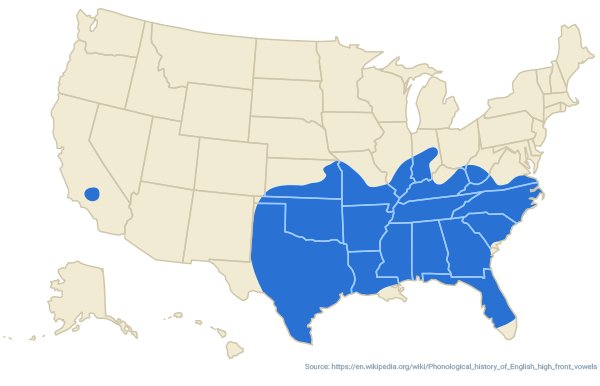
Areas of the U.S. Affected by the Pin-Pen Merger
Are you curious how the Pin-Pen Merger affects you? Find your location on the map below. If you live in a blue area—the Southern states, Texas, and a few other scattered areas—chances are good that most people in your area pronounce pin and pen identically. Most commonly, the merger comes into play when I and E come before nasal consonants like M and N.
Regional Variations Are the Spice of Life!
Before we continue, I want to make an important point. There is absolutely nothing wrong with having different pronunciations for words in various areas of the country or the English-speaking world. Regional differences are fascinating! Our only goal here is to help your child spell words that contain short I and short E sounds.
So let's dig in!
6 Ways to Help Your Child Spell Words with Short I and Short E
Here are six things you can do to tackle short I and short E spelling problems.
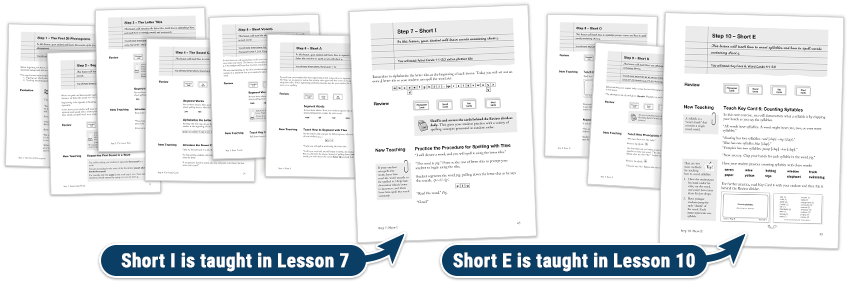
- For beginning spellers, teach words with short I and short E in different lessons. If you try to teach them in the same lesson, you drastically increase the chances that your child will become confused. As a good example of proper spacing, theAll About Spelling Level 1 program teaches words with short I in Lesson 7. Then 3 lessons later, in Lesson 10, words with short E are taught. The space between these lessons gives your child the chance to master one set of words before new (and potentially confusable) words are introduced.
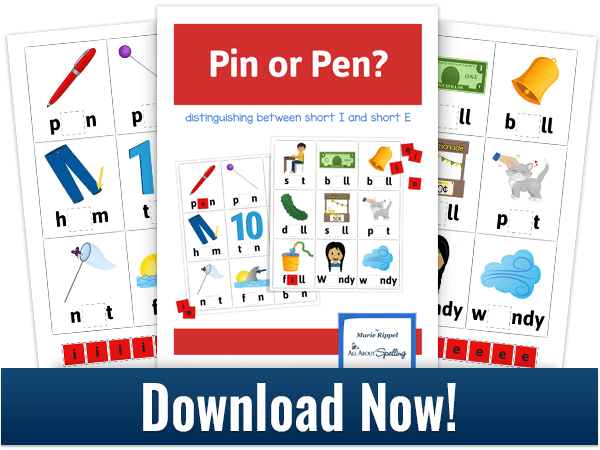
- Provide extra practice. The free activity below will give your child extra practice in distinguishing between short I and short E.
- "Pronounce for spelling." Pronouncing for spelling means that we say the word very clearly, exaggerating the vowel sound. In the normal rhythm of speech, vowel sounds are often muffled. So when it's time to spell, it's important to slow down and drag out the pronunciation so your child can hear the vowel sound very clearly.
- Watch your mouth. Have your child watch your mouth as you make the sounds /ĭ/ and /ĕ/. The mouth should be open taller when you say the short E sound than when you say the short I sound. Now have your child make the sounds while watching himself in the mirror. For some kids, it may be easier to feel this with their mouth than to see it. This part can seem silly, so have fun playing with the sounds as you do this exercise.
- Have your child repeat the dictated word back to you. When you dictate a word for your child to spell, have him say it back to you with the exaggerated pronunciation before he spells it. Make any necessary corrections and have him repeat the pronunciation. When it's time to work on Word Cards, follow this procedure. Say the word normally to see if your child can come up with the correct pronunciation for spelling before he tries to spell the word. For words where this is necessary, your child should remember both the pronunciation and the spelling before moving the card behind the Mastered divider.
- Treat some words as homophones. Finally, you may need to treat some words as homophones. Homophones are words that sound alike but are spelled differently. Where I live, bin and Ben are pronounced differently, but they may sound alike in your area. If this is the case, dictate the word in a sentence so your child has the additional help of hearing the word used in context.
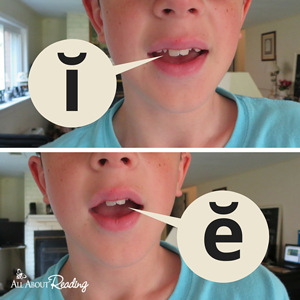
Learning to discriminate between the /ĭ/ and /ĕ/ sounds will help your student immensely in spelling. So working on this skill is well worth the time spent.
Do you live in the beige area on the map or in the blue area? Are your kids affected by the Pin-Pen Merger? Let us know in the comments below! And then download my free "6 Ways We Make Spelling Easy" e-book to learn about more great ways to help your child with spelling.
Source: https://blog.allaboutlearningpress.com/short-i-short-e-confusion/
0 Response to "Easy Way for Kids to Tell the Difference Between Ee and Ea"
Post a Comment